Human culture, the focus of anthropological studies, may be defined compositely as the sum of a group’s learned and shared behaviors. This phenomenon of consistent transmittal, the sharing of experience through time, is apparently unique to our species and is also a basic type of positively reinforcing social behavior. From it arouse the possibility for individuals and cultures to adapt to the natural environment and to begin the process of change and development some scholars have termed “cultural evolution”.
Human diets and food use have always been important subjects to anthropologist. Human nutritional behavior has generally been studied from 3 main points of view, i.e. physiological, psychological and socio-cultural (de Garine, 1972). Nutritional anthropology studies cross-cultural variation in diet, nutritional status and subsistence systems as well as variation in these factors over the evolutionary course of human existence, from prehistoric and historic to modern times. Major questions remain as to how people select diets that are conducive to nutrition and health, particularly in the changing nutritional environments and the dietary prospects for the future (Messer, 1984). Pelto and Jerome (1987) describes nutrition as “the biocultural issues par excellence” because it combines the study of culture and biology. The consequences of food intake are biological, that is, individual biological functioning is directly and continuously affected by food intake over the course of a lifetime. But the nature of food intake – what people eat, how, when, where, and how much – is heavily influenced by social, economic, political, and cultural processes. In other words, how nutrition can affect human behavior and culture and conversely, how culture and human behavior can affect nutrition.
SEAMEO RECFON in collaboration with Nutrition Department, Faculty of Medicine, Universitas Indonesia has introduced the concepts of and methods in anthropology into the curriculum of master program in nutrition since the late 1990s through the course titled Introduction of Nutritional Anthropology. The purposes of the course is 1) to build participants knowledge and skills in assessing the anthropological aspects of nutrition, and 2) to build participants knowledge and skills in developing and applying qualitative research methods to the field of community nutrition.
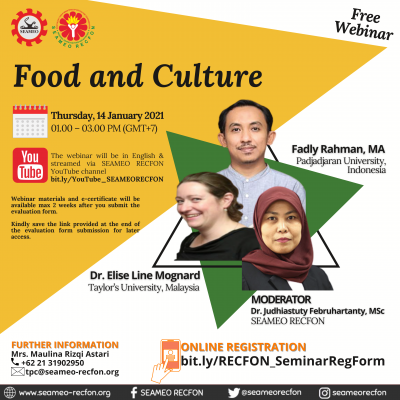
To inspire a more inter-disciplined dialogue, SEAMEO RECFON is organizing a webinar on Food and Culture presenting resource persons who will enrich our understanding on food, its central roles in our lives, and ultimately, its effects on our well-being, especially during the most challenging time of covid-19 pandemic.